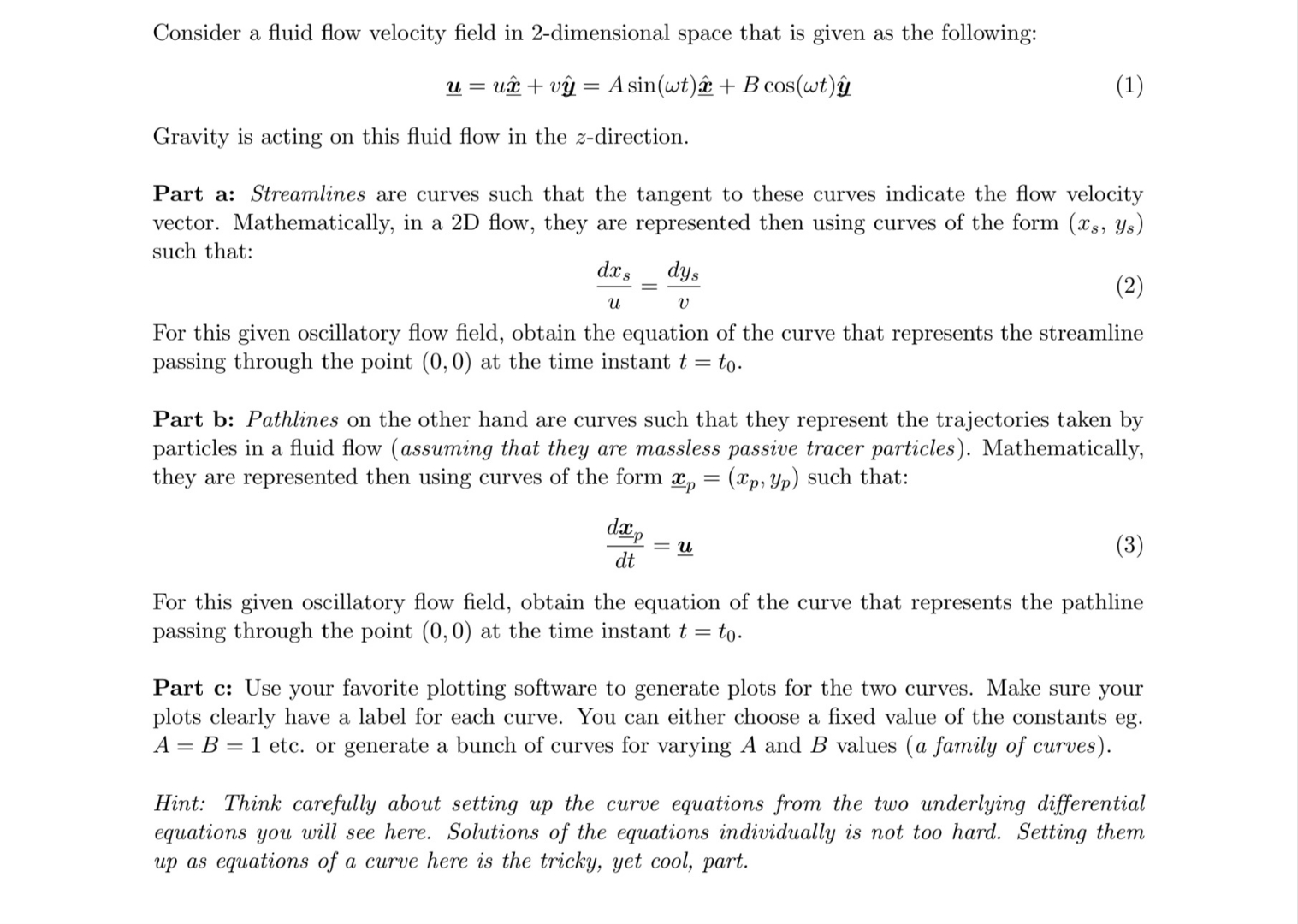
(Solved): Consider a fluid flow velocity field in 2-dimensional space that is given as the following: u_()=uha ...
Consider a fluid flow velocity field in 2-dimensional space that is given as the following:
u_()=uhat(x)_(+)vhat(y)=Asin(\omega t)hat(x)_(+)Bcos(\omega t)hat(y)Gravity is acting on this fluid flow in the
z-direction. Part a: Streamlines are curves such that the tangent to these curves indicate the flow velocity vector. Mathematically, in a 2D flow, they are represented then using curves of the form
(x_(s),y_(s))such that:
(dx_(s))/(u)=(dy_(s))/(v)For this given oscillatory flow field, obtain the equation of the curve that represents the streamline passing through the point
(0,0)at the time instant
t=t_(0). Part b: Pathlines on the other hand are curves such that they represent the trajectories taken by particles in a fluid flow (assuming that they are massless passive tracer particles). Mathematically, they are represented then using curves of the form
x_(_())(p)=(x_(p),y_(p))such that:
(dx_(_())(p))/(dt)=u_()For this given oscillatory flow field, obtain the equation of the curve that represents the pathline passing through the point
(0,0)at the time instant
t=t_(0). Part c: Use your favorite plotting software to generate plots for the two curves. Make sure your plots clearly have a label for each curve. You can either choose a fixed value of the constants eg.
A=B=1etc. or generate a bunch of curves for varying
Aand
Bvalues (a family of curves). Hint: Think carefully about setting up the curve equations from the two underlying differential equations you will see here. Solutions of the equations individually is not too hard. Setting them up as equations of a curve here is the tricky, yet cool, part.