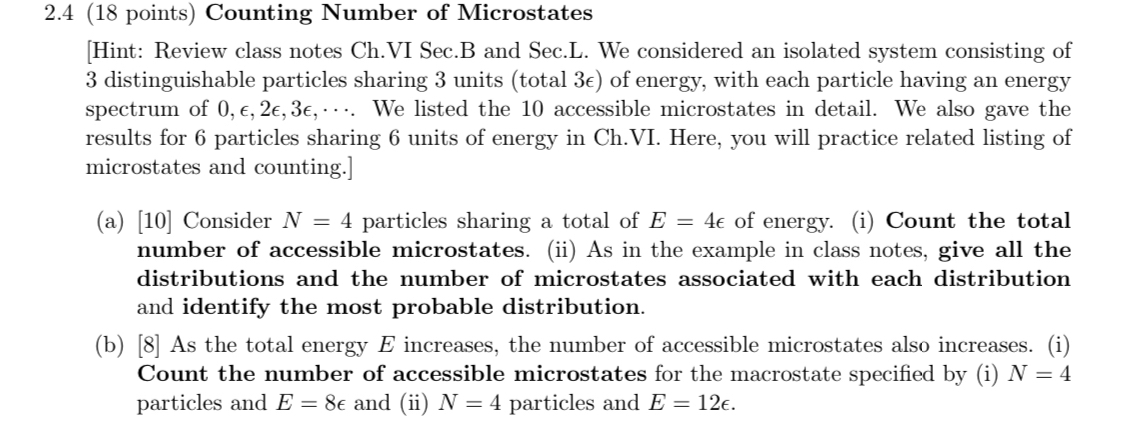
(Solved): 2.4 (18 points) Counting Number of Microstates [Hint: Review class notes Ch.VI Sec.B and Sec.L. We ...
2.4 (18 points) Counting Number of Microstates [Hint: Review class notes Ch.VI Sec.B and Sec.L. We considered an isolated system consisting of 3 distinguishable particles sharing 3 units (total
3\epsi lon) of energy, with each particle having an energy spectrum of
0,\epsi lon,2\epsi lon,3\epsi lon,cdots. We listed the 10 accessible microstates in detail. We also gave the results for 6 particles sharing 6 units of energy in Ch.VI. Here, you will practice related listing of microstates and counting.] (a) [10] Consider
N=4particles sharing a total of
E=4\epsi lonof energy. (i) Count the total number of accessible microstates. (ii) As in the example in class notes, give all the distributions and the number of microstates associated with each distribution and identify the most probable distribution. (b) [8] As the total energy
Eincreases, the number of accessible microstates also increases. (i) Count the number of accessible microstates for the macrostate specified by (i)
N=4particles and
E=8\epsi lonand (ii)
N=4particles and
E=12\epsi lon