Home /
Expert Answers /
Advanced Math /
2-application-to-interpolating-surfaces-let-us-next-consider-a-regular-grid-of-points-x-i-y-j-pa422
(Solved): 2 Application to Interpolating Surfaces Let us next consider a regular grid of points (x_(i),y_(j)) ...
2 Application to Interpolating Surfaces Let us next consider a regular grid of points
(x_(i),y_(j))and the surface values
z_(ij)=f(x_(i),y_(j)). Let
x=(x_(0),dots,x_(m))inR^(m+1)and
y=(y_(0),dots,y_(n))in
R^(n+1). In this setting the surface can be interpolated using a product (tensor product) of univariate interpolation polynomials. In the sequel we denote the
y-dependent quantities with a bar, for instance,
/bar (l)_(q)(t)for the corresponding Lagrange basis polynomial in the
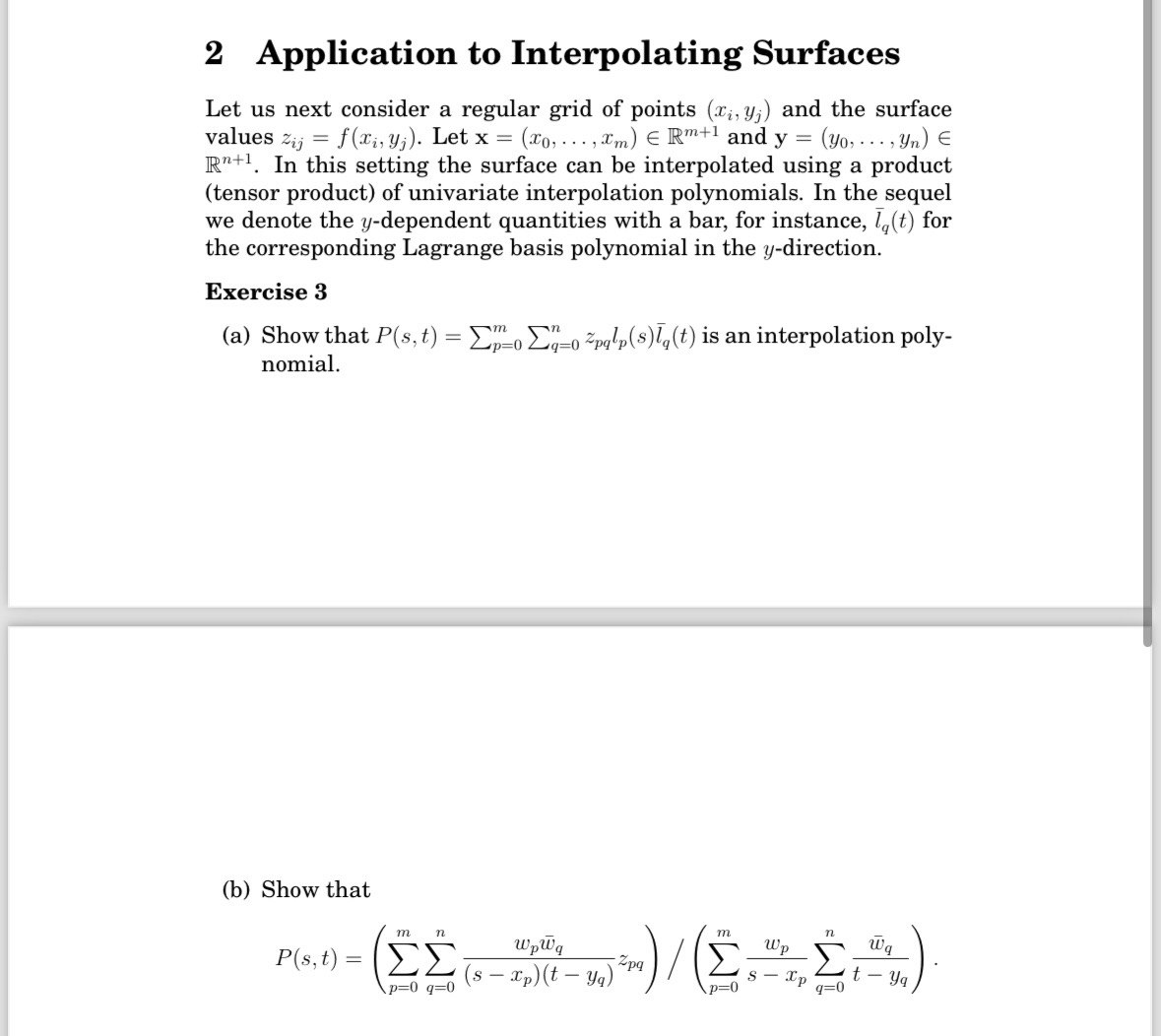
y-direction. Exercise 3 (a) Show that
P(s,t)=\sum_(p=0)^m \sum_(q=0)^n z_(pq)l_(p)(s)/(b)ar (l)_(q)(t)is an interpolation poly- nomial. (b) Show that
P(s,t)=(\sum_(p=0)^m \sum_(q=0)^n ((w_(p))/(b)ar (w)_(q))/((s-x_(p))(t-y_(q)))z_(pq))/(\sum_(p=0)^m (w_(p))/(s-x_(p))\sum_(q=0)^n (/bar (w)_(q))/(t-y_(q))).