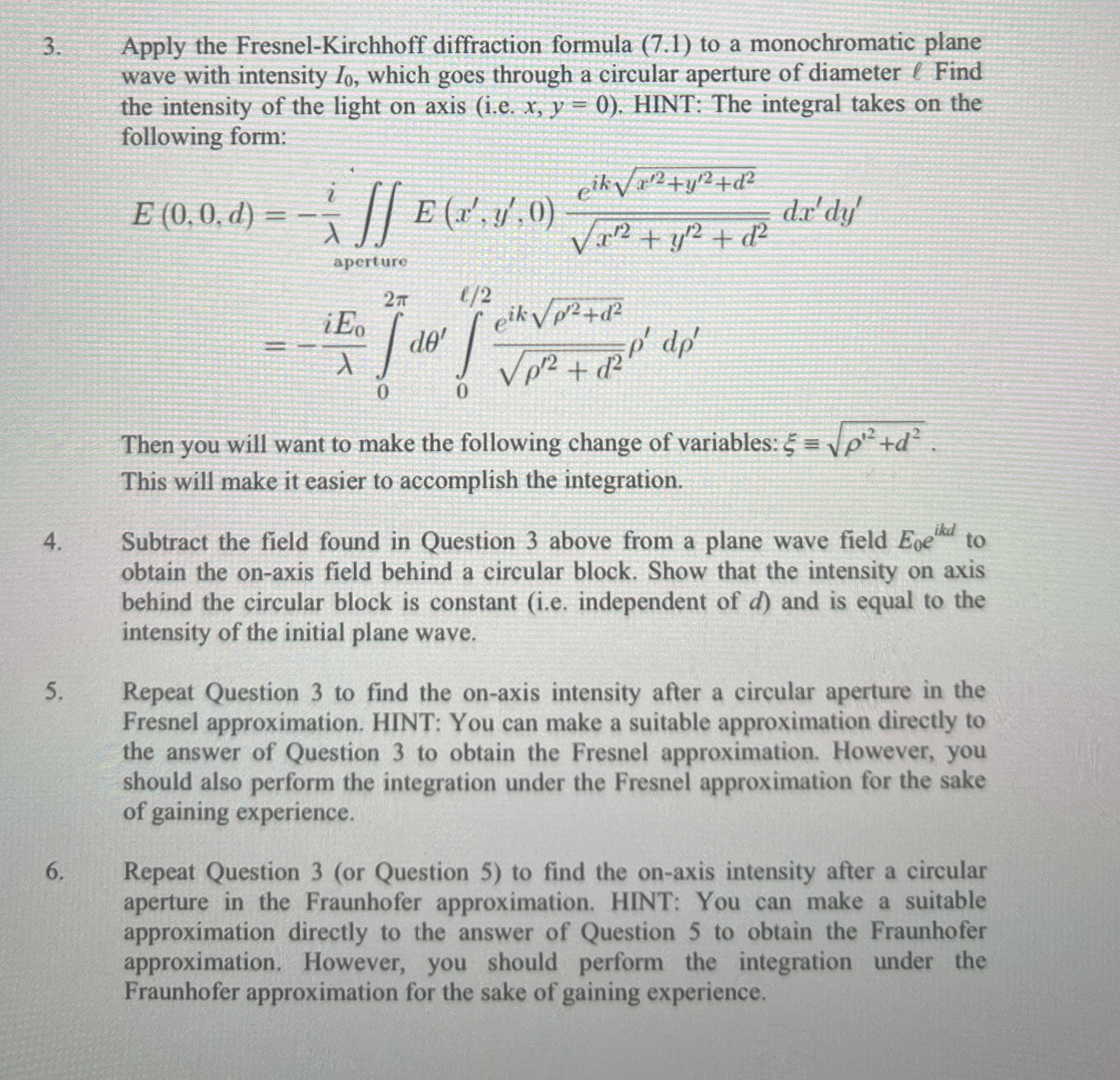
(Solved): Apply the Fresnel-Kirchhoff diffraction formula (7.1) to a monochromatic plane wave with intensit ...
Apply the Fresnel-Kirchhoff diffraction formula (7.1) to a monochromatic plane wave with intensity
I_(0), which goes through a circular aperture of diameter
lFind the intensity of the light on axis (i.e.
x,y=0). HINT: The integral takes on the following form:
E(0,0,d)=-(i)/(\lambda )∬_(aperture )E(x^('),y^('),0)(e^(ik\sqrt(x^('2)+y^('2)+d^(2))))/(\sqrt(x^('2)+y^('2)+d^(2)))dx^(')dy^(')
=-(iE_(0))/(\lambda )\int_0^(2\pi ) d\theta ^(')\int_0^((l)/(2)) (e^(ik\sqrt(\rho ^('2)+d^(2))))/(\sqrt(\rho ^('2)+d^(2)))\rho ^(')d\rho ^(')
Then you will want to make the following change of variables:
\xi -=\sqrt(\rho ^('2)+d^(2)). This will make it easier to accomplish the integration. 4. Subtract the field found in Question 3 above from a plane wave field
E_(0)e^(ikd)to obtain the on-axis field behind a circular block. Show that the intensity on axis behind the circular block is constant (i.e. independent of
d) and is equal to the intensity of the initial plane wave.Apply the Fresnel-Kirchhoff diffraction formula (7.1) to a monochromatic plane wave with intensity
I_(0), which goes through a circular aperture of diameter
lFind the intensity of the light on axis (i.e.
x,y=0). HINT: The integral takes on the following form:
E(0,0,d)=-(i)/(\lambda )∬_(aperture )E(x^('),y^('),0)(e^(ik\sqrt(x^('2)+y^('2)+d^(2))))/(\sqrt(x^('2)+y^('2)+d^(2)))dx^(')dy^(')
=-(iE_(0))/(\lambda )\int_0^(2\pi ) d\theta ^(')\int_0^((l)/(2)) (e^(ik\sqrt(\rho ^('2)+d^(2))))/(\sqrt(\rho ^('2)+d^(2)))\rho ^(')d\rho ^(')
Then you will want to make the following change of variables:
\xi -=\sqrt(\rho ^('2)+d^(2)). This will make it easier to accomplish the integration. 4. Subtract the field found in Question 3 above from a plane wave field
E_(0)e^(ikd)to obtain the on-axis field behind a circular block. Show that the intensity on axis behind the circular block is constant (i.e. independent of
d) and is equal to the intensity of the initial plane wave. Apply the Fresnel-Kirchhoff diffraction formula (7.1) to a monochromatic plane wave with intensity
I_(0), which goes through a circular aperture of diameter
lFind the intensity of the light on axis (i.e.
x,y=0). HINT: The integral takes on the following form:
E(0,0,d)=-(i)/(\lambda )∬_(aperturo )E(x^('),y^('),\theta )(e^(ik\sqrt(x^('2)+y^('2)+d^(2))))/(\sqrt(x^('2)+y^('2)+d^(2)))dx^(')dy^(')
=-(iE_(0))/(\lambda )\int_0^(2\pi ) d\theta ^(')\int_0^((l)/(2)) (e^(ik\sqrt(\rho ^('2)+d^(2))))/(\sqrt(\rho ^('2)+d^(2)))\rho ^(')d\rho ^(')
Then you will want to make the following change of variables:
\xi -=\sqrt(\rho ^('2)+d^(2)). This will make it easier to accomplish the integration. 4. Subtract the field found in Question 3 above from a plane wave field
E_(0)e^(ikd)to obtain the on-axis field behind a circular block. Show that the intensity on axis behind the circular block is constant (i.e. independent of
d) and is equal to the intensity of the initial plane wave. 5. Repeat Question 3 to find the on-axis intensity after a circular aperture in the Fresnel approximation. HINT: You can make a suitable approximation directly to the answer of Question 3 to obtain the Fresnel approximation. However, you should also perform the integration under the Fresnel approximation for the sake of gaining experience. 6. Repeat Question 3 (or Question 5) to find the on-axis intensity after a circular aperture in the Fraunhofer approximation. HINT: You can make a suitable approximation directly to the answer of Question 5 to obtain the Fraunhofer approximation. However, you should perform the integration under the Fraunhofer approximation for the sake of gaining experience.