Home /
Expert Answers /
Calculus /
consider-the-differential-equation-dp-dt-kp-1-c-where-k-gt-0-and-c-gt-0-in-section-3-1-we-sa-pa143
(Solved): Consider the differential equation (dP)/(dt)=kP^(1+c) where k>0 and c>=0. In Section 3.1 we sa ...
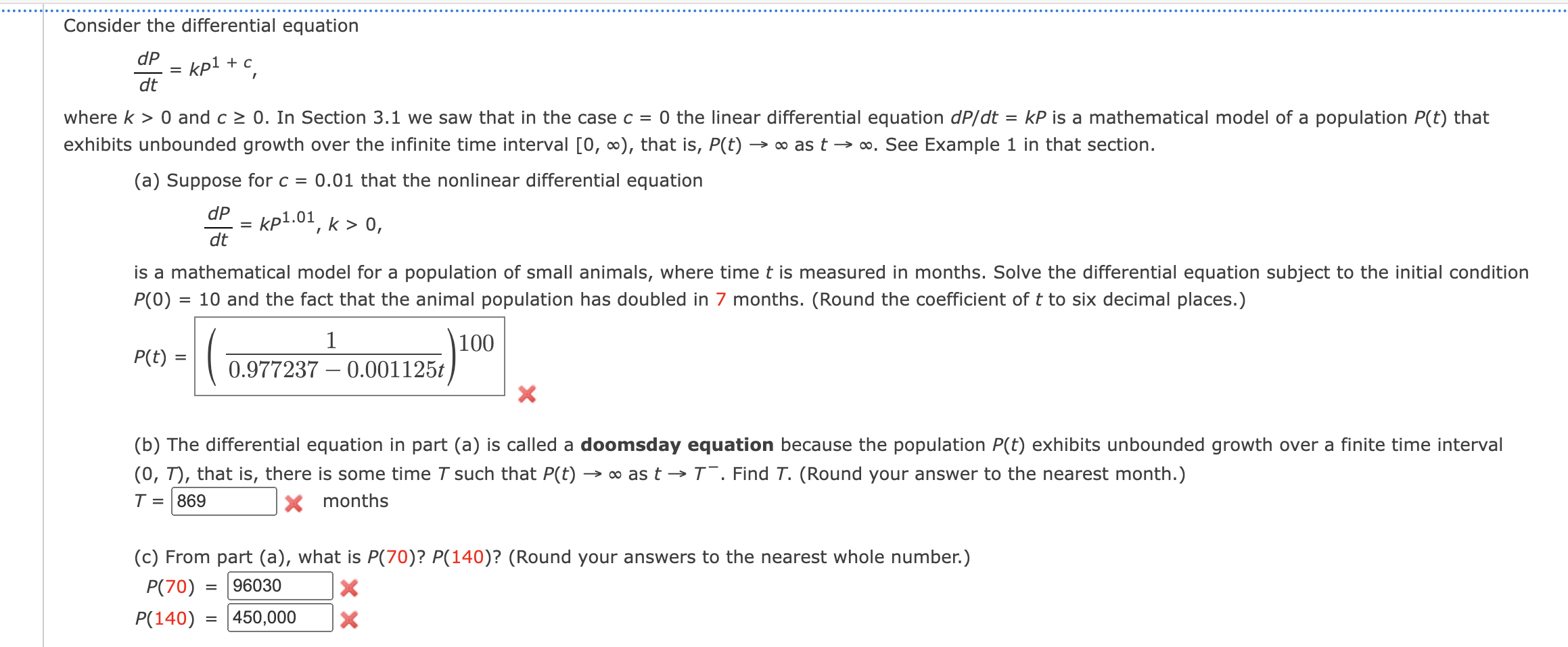
Consider the differential equation
(dP)/(dt)=kP^(1+c)
where k>0 and c>=0. In Section 3.1 we saw that in the case c=0 the linear differential equation d(P)/(d)t=kP is a mathematical model of a population P(t) that
exhibits unbounded growth over the infinite time interval [0,\infty ), that is, P(t)->\infty as t->\infty . See Example 1 in that section.
(a) Suppose for c=0.01 that the nonlinear differential equation
(dP)/(dt)=kP^(1.01),k>0
is a mathematical model for a population of small animals, where time t is measured in months. Solve the differential equation subject to the initial condition
P(0)=10t to six decimal places.P(t)=((1)/(0.977237-0.001125t))100
(b) The differential equation in part (a) is called a doomsday equation because the population P(t) exhibits unbounded growth over a finite time interval
(0,T), that is, there is some time T such that P(t)->\infty as t->T^(-). Find T. (Round your answer to the nearest month.)
T=
months
(c) From part (a), what is P(70) ? P(140) ? (Round your answers to the nearest whole number.)
P(70)=
P(140)=