Home /
Expert Answers /
Physics /
example-15-5-electric-field-due-to-two-point-charges-goal-use-the-superposition-principle-to-calcula-pa415
(Solved): EXAMPLE 15.5 ELECTRIC FIELD DUE TO TWO POINT CHARGES GOAL Use the superposition principle to calcula ...
EXAMPLE 15.5 ELECTRIC FIELD DUE TO TWO POINT CHARGES
GOAL Use the superposition principle to calculate
the electric field due to two point charges.
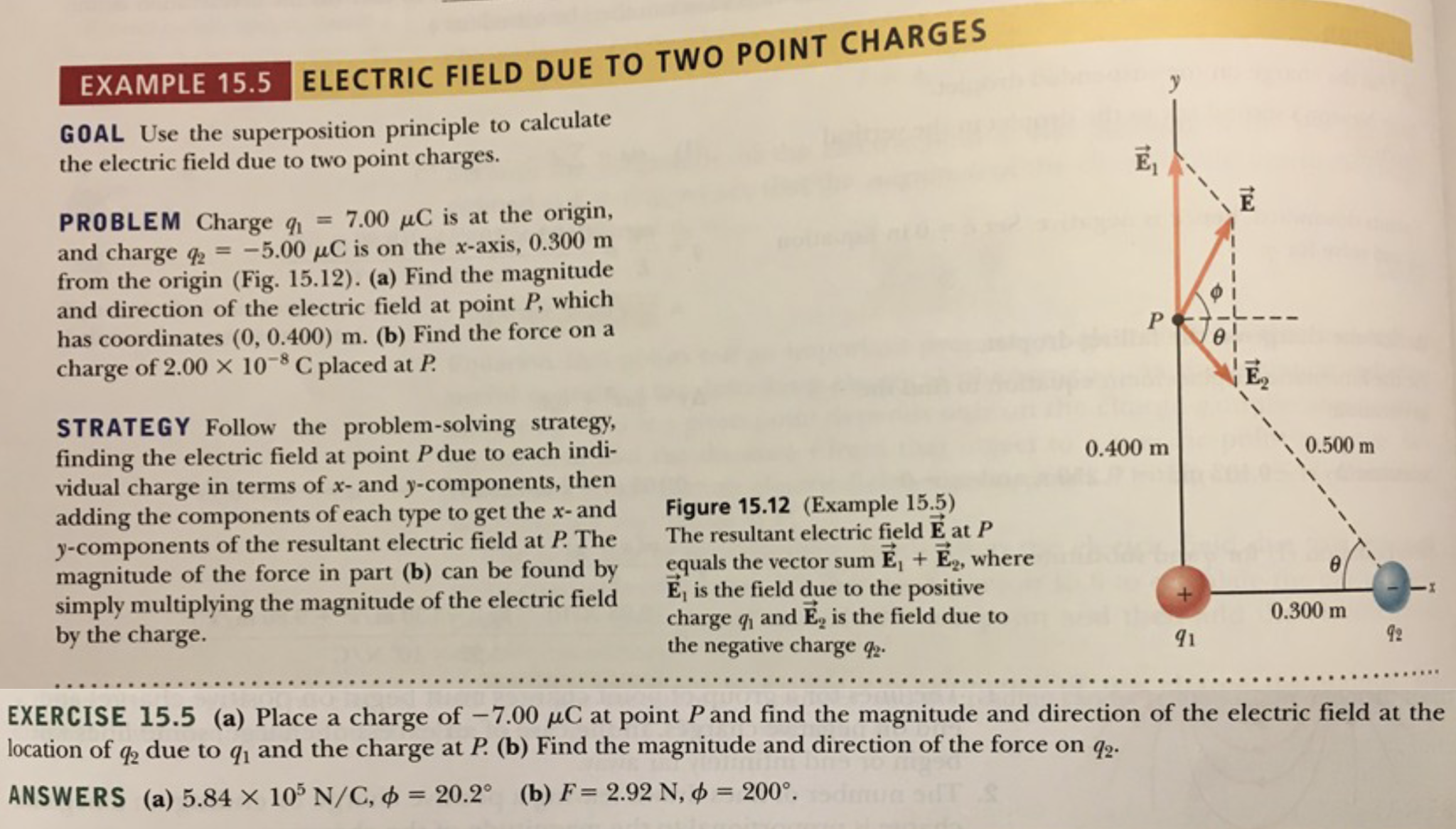
PROBLEM Charge q_(1)=7.00\mu C is at the origin,
and charge q_(2)=-5.00\mu C is on the x-axis, 0.300 m
from the origin (Fig. 15.12). (a) Find the magnitude
and direction of the electric field at point P, which
has coordinates (0,0.400)m. (b) Find the force on a
charge of 2.00\times 10^(-8)C placed at P.
STRATEGY Follow the problem-solving strategy,
finding the electric field at point P due to each indi-
vidual charge in terms of x - and y-components, then
adding the components of each type to get the x-and
y-components of the resultant electric field at P. The
magnitude of the force in part (b) can be found by
simply multiplying the magnitude of the electric field
by the charge.
Figure 15.12 (Example 15.5)
The resultant electric field vec(E) at P
equals the vector sum vec(E)_(1)+vec(E)_(2), where
vec(E)_(1) is the field due to the positive
charge q_(1) and vec(E)_(2) is the field due to
the negative charge q_(2).
EXERCISE 15.5 (a) Place a charge of -7.00\mu C at point P and find the magnitude and direction of the electric field at the
location of q_(2) due to q_(1) and the charge at P. (b) Find the magnitude and direction of the force on q_(2).
ANSWERS
(a) 5.84\times 10^(5)(N)/(C),\phi =20.2\deg
(b) F=2.92N,\phi =200\deg .