Home /
Expert Answers /
Physics /
ii-electric-field-principle-of-superposition-gauss-39-s-law-electric-potential-energy-the-principl-pa545
(Solved): II. ELECTRIC FIELD; PRINCIPLE OF SUPERPOSITION; GAUSS'S LAW; ELECTRIC POTENTIAL; ENERGY The principl ...
II. ELECTRIC FIELD; PRINCIPLE OF SUPERPOSITION; GAUSS'S LAW; ELECTRIC POTENTIAL; ENERGY The principle of superposition. The electric of point charges obeys the law of superposition:
E=E_(1)+E_(2)+dots+E_(n). Where
E_(i)=(kQ_(i))/(R_(i)^(3))R_(i)is the electric field of point charge
Q_(i). For a system of distributed charges this principle is reduced to
E=\int (kdq)/(R^(3))R. The same principle is valid for the electric potential corresponding to the field (determined as
dV=-E*dr, or
E=-gradV):
V=V_(1)+V_(2)+dots+V_(n),
V_(1)=(kQ_(i))/(R_(i)); for a continuous charge
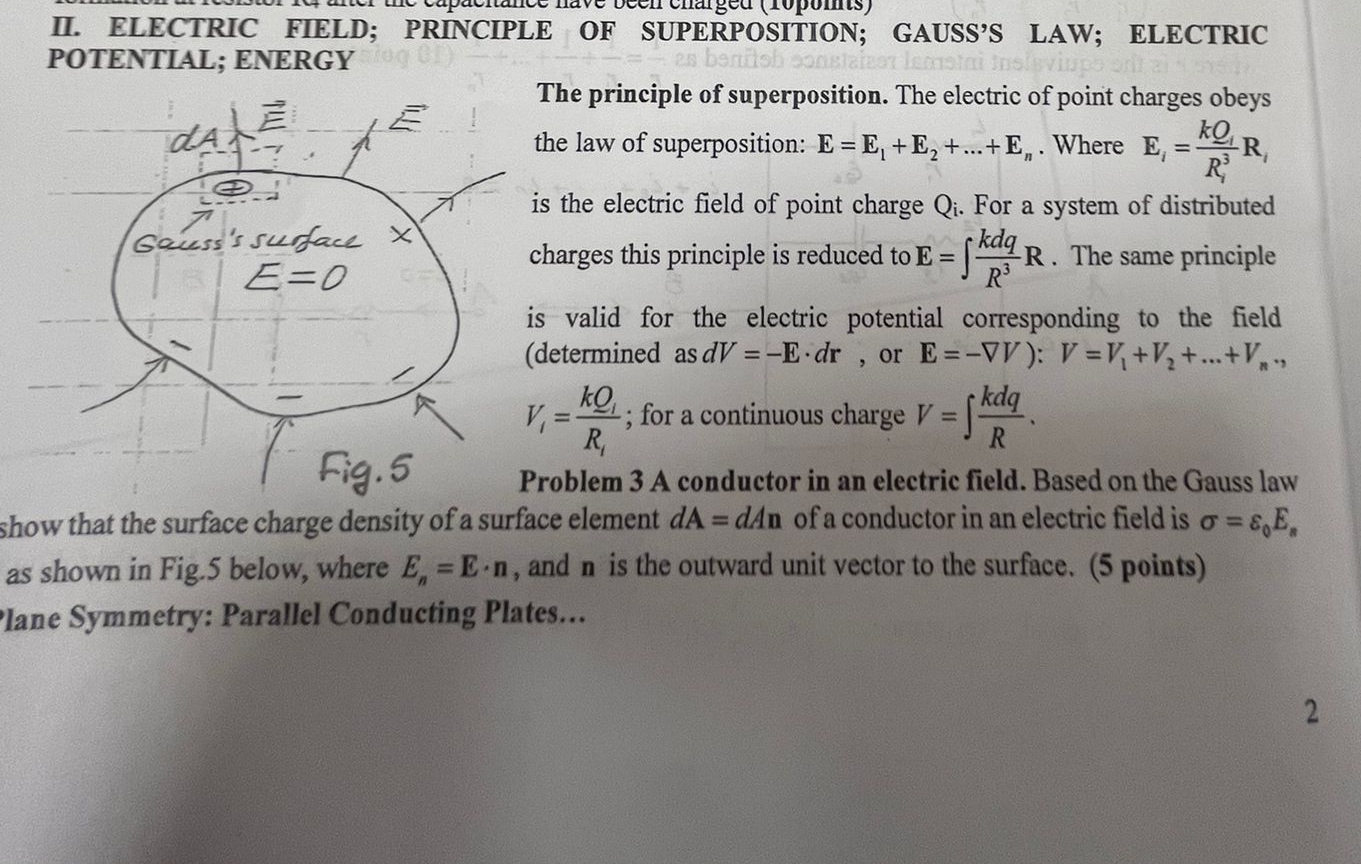
V=\int (kdq)/(R). Problem 3 A conductor in an electric field. Based on the Gauss law show that the surface charge density of a surface element
dA=dAnof a conductor in an electric field is
\sigma =\epsi _(0)E_(n)as shown in Fig. 5 below, where
E_(n)=E*n, and
nis the outward unit vector to the surface. (5 points) lane Symmetry: Parallel Conducting Plates... 2