Home /
Expert Answers /
Advanced Math /
remark-you-proved-in-class-that-l-f-t-a-u-t-a-e-as-l-f-t-this-will-be-useful-for-two-purposes-pa236
(Solved): Remark. You proved in class that L{f(t-a)u(t-a)}=e^(-as)L{f(t)} This will be useful for two purposes ...
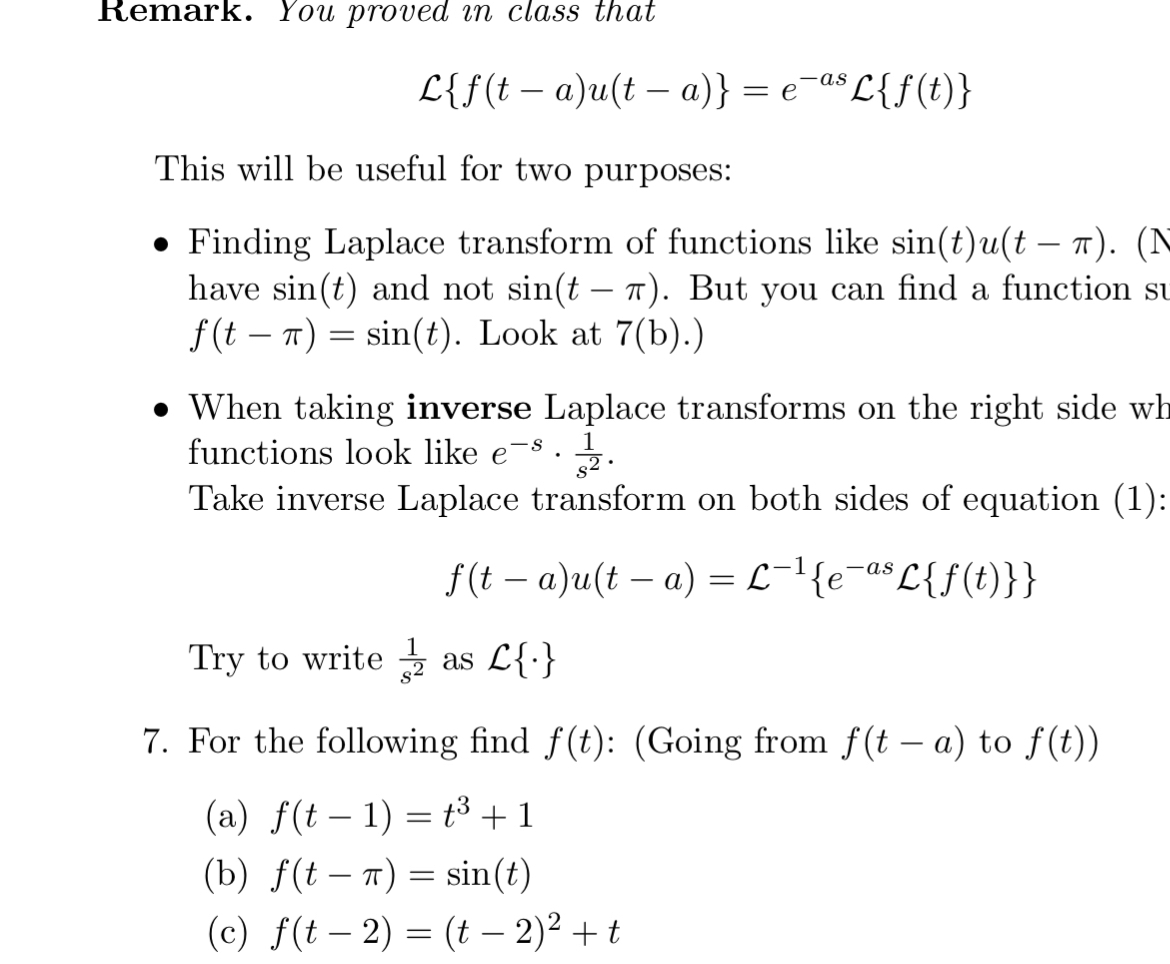
Remark. You proved in class that
L{f(t-a)u(t-a)}=e^(-as)L{f(t)}This will be useful for two purposes: Finding Laplace transform of functions like
sin(t)u(t-\pi ). have
sin(t)and not
sin(t-\pi ). But you can find a function si
f(t-\pi )=sin(t). Look at
7(b).) When taking inverse Laplace transforms on the right side wh functions look like
e^(-s)*(1)/(s^(2)). Take inverse Laplace transform on both sides of equation (1):
f(t-a)u(t-a)=L^(-1){e^(-as)L{f(t)}}Try to write
(1)/(s^(2))as
L{*}7. For the following find
f(t): (Going from
f(t-a)to
f(t)) (a)
f(t-1)=t^(3)+1(b)
f(t-\pi )=sin(t)(c)
f(t-2)=(t-2)^(2)+t