(Solved): The pendulum oscillation is described by the initial-value problem consisting of the equation of m ...
The pendulum oscillation is described by the initial-value problem consisting of the equation of motion with initial conditions:
\theta ^(¨)+(g)/(L)sin(\theta )=0,\theta (t_(0))=\theta _(0),\theta ^(˙)(t_(0))=\omega _(0)Here,
Lis the length of the pendulum,
gacceleration due to gravity,
\theta the angle the pendulum makes with the vertical,
\theta _(0)the initial angular displacement, and
\omega _(0)the initial angular velocity. a) Transform the second-order initial-value problem into a system of first-order initial-value problems. b) Compute the angular displacement
\theta (0.2)and angular velocity
\theta ^(˙)(0.2)using the forward Euler method with step size
h=0.1. Use
L=0.5m,g=9.81(m)/(s^(2)),t_(0)=0,\theta _(0)=(\pi )/(4)rad, and
\omega _(0)
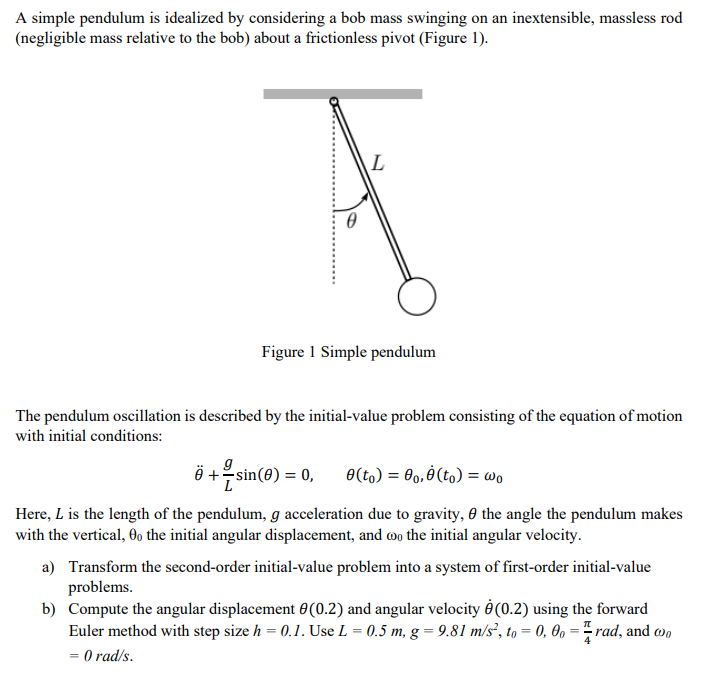
=0ra(d)/(s).help please A simple pendulum is idealized by considering a bob mass swinging on an inextensible, massless rod (negligible mass relative to the bob) about a frictionless pivot (Figure 1). Figure 1 Simple pendulum The pendulum oscillation is described by the initial-value problem consisting of the equation of motion with initial conditions: \theta ̈+g/Lsin (\theta )=0, \theta (t_0)=\theta _0, \theta ̇(t_0)=\omega _0 Here, L is the length of the pendulum, g acceleration due to gravity, \theta the angle the pendulum makes with the vertical, \theta _0 the initial angular displacement, and \omega _0 the initial angular velocity. a) Transform the second-order initial-value problem into a system of first-order initial-value problems. b) Compute the angular displacement \theta (0.2) and angular velocity \theta (0.2) using the forward Euler method with step size h=0.1. Use L=0.5 m, g=9.81 m / s^2, t_0=0, \theta _0=\pi /4 r a d, and \omega _0 =0 rad / s.