Home /
Expert Answers /
Electrical Engineering /
two-n-type-semiconductor-samples-are-uniformly-doped-with-the-same-donor-concentration-of-n-d-10-pa359
(Solved): Two n-type semiconductor samples are uniformly doped with the same donor concentration of N_(D)=(10^ ...
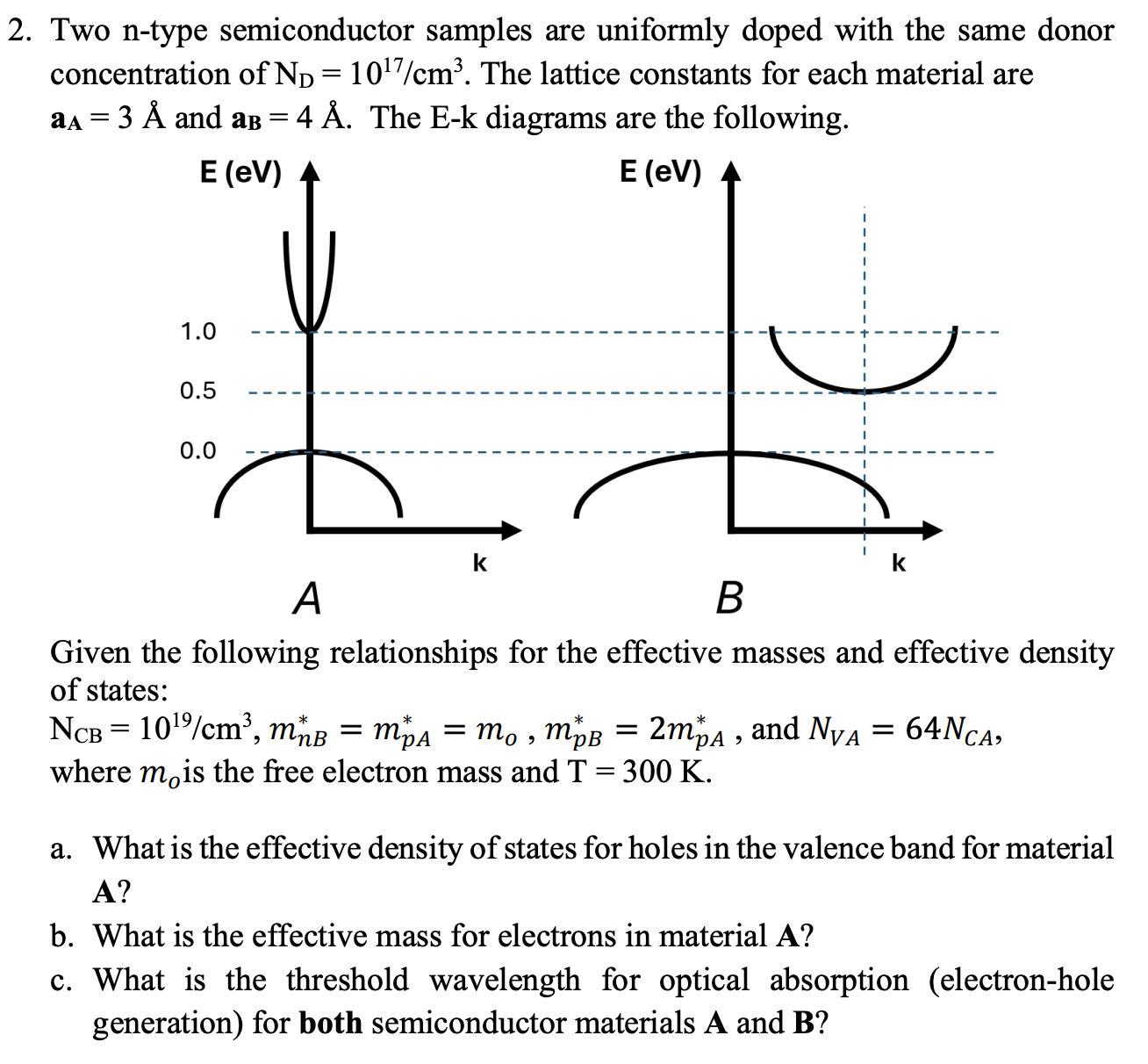
Two n-type semiconductor samples are uniformly doped with the same donor
concentration of N_(D)=(10^(17))/(c)m^(3). The lattice constants for each material are
a_(A)=3\angstrom and a_(B)=4\angstrom . The E-k diagrams are the following.
Given the following relationships for the effective masses and effective density
of states:
N_(CB)=(10^(19))/(c)m^(3),m_(nB)^(*)=m_(pA)^(*)=m_(o),m_(pB)^(*)=2m_(pA)^(*), and N_(VA)=64N_(CA),
where m_(o) is the free electron mass and T=300K.
a. What is the effective density of states for holes in the valence band for material
A?
b. What is the effective mass for electrons in material A ?
c. What is the threshold wavelength for optical absorption (electron-hole
generation) for both semiconductor materials A and B ?
d. What is the change in momentum for electrons transitioning from the valence
band to the conduction band for both semiconductor materials?
e. What is the concentration of holes in cm^(-3) for material B ?