Home /
Expert Answers /
Advanced Physics /
we-abtain-d-epsi-sqrt-2-epsi-m-3-2-pi-2-3-and-v-sqrt-2-epsi-m-pa416
(Solved): We abtain ; D(\epsi )=(\sqrt(2\epsi )m^(**(3)/(2)))/(\pi ^(2)^(3)), and ,|V|=\sqrt((2\epsi )/(m^( ...
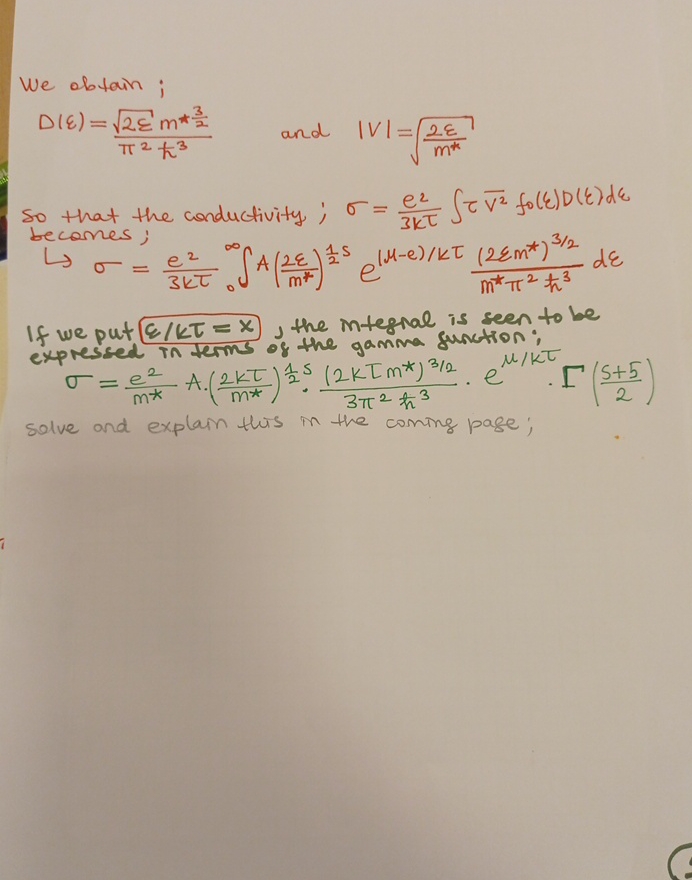
We abtain ;
D(\epsi )=(\sqrt(2\epsi )m^(**(3)/(2)))/(\pi ^(2)ℏ^(3)), and ,|V|=\sqrt((2\epsi )/(m^(**)))So that the conductivity;
\sigma =(e^(2))/(3k\tau )\int (\tau )/(b)ar (V^(2))f_(0)(\epsi )D(\epsi )d\epsi becomes;
L_(0)=(e^(2))/(3k\tau )\int_0^(\infty ) A((2\epsi )/(m^(**)))^((1)/(2)s)e^((\mu -e)/(k)\tau )((2\epsi m^(**))^((3)/(2)))/(m^(**)\pi ^(2)ℏ^(3))d\epsi If we put
(\epsi )/(k)\tau =x, the integnal is seen to be expressed in terms of the gamima gunction;
\sigma =(e^(2))/(m^(**))A*((2k\tau )/(m^(**)))^((1)/(2)s)*((2k\tau m^(**))^((3)/(2)))/(3\pi ^(2)ℏ^(3))*e^((\mu )/(k)\tau )*\Gamma ((s+5)/(2))solve and explain this in the coming page; can you please step by step in a beginner friendly way explain and solve with all steps